What is frozen shoulder?
Frozen shoulder, known clinically as adhesive capsulitis, is a condition where the capsule surrounding your shoulder joint becomes inflamed, thickened, and tight, which gradually limits how far and how comfortably you can move your arm. The shoulder capsule is the connective tissue that wraps around the ball and socket of the joint; when it stiffens and loses its normal slack, the joint simply doesn’t have the room it needs to move.
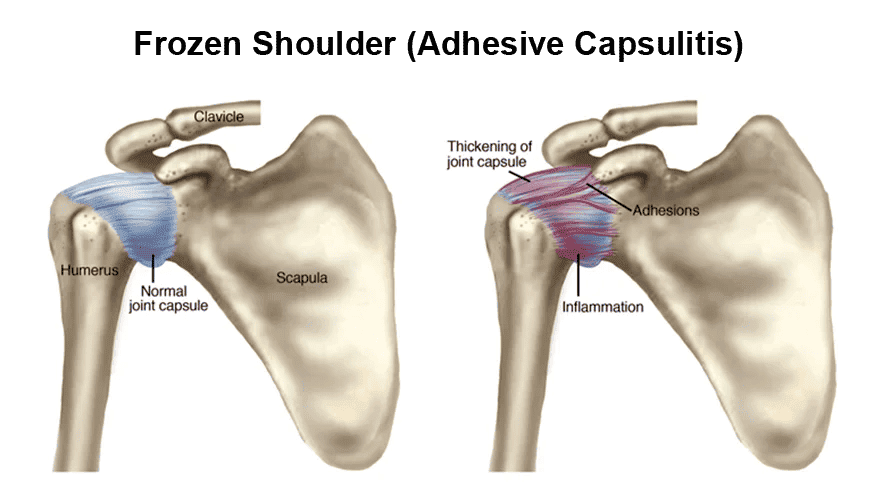
It most often affects adults between 40 and 60, is more common in women, and shows up more frequently in people with diabetes or thyroid conditions, or after a period where the arm was immobilized following an injury or surgery. Many people notice it without any clear injury at all, which is part of what makes it so frustrating. The good news is that frozen shoulder has a predictable course, and knowing where you are in that course makes a real difference in how it’s treated.
Main symptoms
The two hallmark symptoms of frozen shoulder are pain and a loss of mobility, and the balance between them shifts as the condition progresses.
Pain. Early on, pain is usually the dominant complaint. It tends to be a deep, aching pain in the shoulder that can spread toward the upper arm, and it’s often worse at night, especially when lying on the affected side. Quick or unexpected movements, like reaching to catch something, can bring on a sharp spike.
Mobility restrictions. Over time, the shoulder gets progressively stiffer. Everyday tasks like reaching overhead to a shelf, putting on a jacket, fastening a bra, or reaching into your back pocket become difficult or impossible. What sets frozen shoulder apart from a muscle strain or tendon issue is that the stiffness is there whether you try to move the arm yourself or someone else (like a physical therapist) moves it for you.
The capsular pattern. Frozen shoulder loses motion in a specific, recognizable order called the capsular pattern. External rotation (turning the arm outward, like opening a door with your forearm) is the most limited, followed by abduction (lifting the arm out to the side), and then flexion (reaching forward). This pattern is one of the key things a physical therapist looks for during an evaluation, because it helps distinguish frozen shoulder from other causes of shoulder pain like rotator cuff problems or impingement.
The three phases of frozen shoulder
Frozen shoulder typically moves through three overlapping phases. The timelines vary from person to person, but the general progression is consistent.
- Freezing (painful phase). Pain gradually increases and the shoulder starts to lose range of motion. This phase usually lasts anywhere from about 6 weeks to 9 months, and it’s often when people first start looking for help because the pain, especially at night, becomes hard to ignore.
- Frozen (stiff phase). Pain often begins to ease, but stiffness is at its worst. The shoulder can feel locked in place, and daily activities are most limited during this stretch, which commonly lasts 4 to 6 months.
- Thawing (recovery phase). Range of motion slowly returns and the shoulder starts to feel more like itself again. This phase can last anywhere from 6 months to 2 years depending on how much motion was lost and how the shoulder is managed.
Understanding which phase you’re in matters because the right treatment in one phase can be the wrong treatment in another. Aggressive stretching during the painful freezing phase, for example, can irritate the shoulder and set you back.
Prognosis: why early treatment matters
Frozen shoulder does usually resolve on its own, but “on its own” can mean living with pain and limited motion for 1 to 3 years, and some people never fully regain their previous range of motion.
When it’s treated early, the outlook is much better. A combination of physical therapy and, when appropriate, a cortisone injection from your physician can calm the inflammation in the capsule, reduce pain, and help preserve range of motion before the shoulder stiffens significantly. The injection addresses the inflammation driving the pain, while physical therapy keeps the joint moving and guides you safely through each phase. Getting started in the freezing phase, rather than waiting until the shoulder is already locked up, gives you the best chance at a shorter, less painful recovery.
How physical therapy treats each phase
Treatment for frozen shoulder isn’t one-size-fits-all; it changes as the shoulder moves through each phase.
Phase 1: Freezing. The goal here is to calm the shoulder down while keeping as much motion as possible. Treatment focuses on gentle passive range of motion (PROM), where the therapist moves your arm for you within a comfortable range so the joint keeps moving without provoking more pain. Sessions end with isometric exercises, where you contract the shoulder muscles without actually moving the joint. Isometrics help reduce pain and keep the muscles engaged without irritating an already inflamed capsule.
Phase 2: Frozen. Once pain has settled and stiffness is the main problem, treatment shifts toward restoring motion. This is where stretching becomes the priority, targeting the directions of the capsular pattern that are most restricted. Eccentric exercises, where the muscle lengthens under control, are introduced to build strength through a growing range of motion and help the tissue tolerate load again.
Phase 3: Thawing. As mobility improves, the focus turns to rebuilding shoulder strength so you can use that motion confidently in daily life, at the gym, or in your sport. Strengthening the rotator cuff and the muscles around the shoulder blade helps restore normal shoulder mechanics and reduces the chance of lingering weakness or compensation patterns.
Don’t wait it out
If your shoulder has been getting more painful and harder to move, especially if it’s keeping you up at night or you’ve noticed you can’t reach behind your back or overhead like you used to, it’s worth getting it looked at sooner rather than later. A thorough evaluation can confirm whether it’s frozen shoulder or something else, identify which phase you’re in, and build a plan that fits where your shoulder is right now.
At PT with Dani in Old Town Alexandria, I work one-on-one with active adults to get them moving comfortably again. If you’re dealing with shoulder pain or stiffness, book a free 15-minute consultation and we can talk through what’s going on and whether physical therapy is the right next step for you.

Be The First To Comment